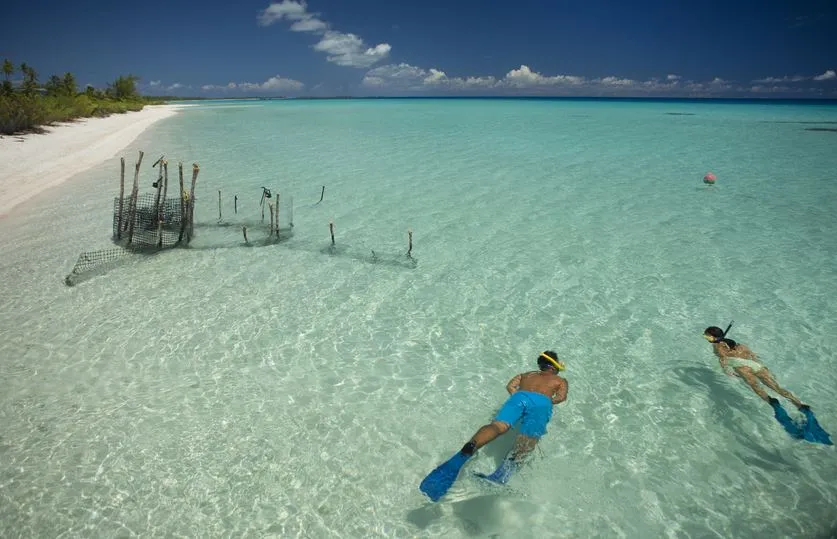

French Polynesia's exclusive economic zone covers about 5.5 million square kilometres of the South Pacific, and nearly every island sits inside a reef with its own mix of lagoon, pass and open ocean. That variety is why one trip can include blacktip reef sharks in knee-deep water, manta rays at a cleaning station and, in the right months, humpback whales offshore. This guide explains what lives where, when the seasonal visitors arrive and how local rules shape the way encounters are run.
Three habitats, three kinds of encounter
The lagoon is the sheltered water between the shore and the barrier reef. It is where most visitors first meet reef fish, blacktip reef sharks, stingrays, spotted eagle rays and turtles, usually with a mask and snorkel from a boat tour or a hotel jetty. Depth is often modest, the water is warm and conditions are gentle compared with the ocean side.
The passes are the channels where lagoon water empties into the ocean and refills with the tide. Currents there bring in schools of barracuda, jacks and surgeonfish, and the predators that follow them. Pass diving is drift diving: you ride the incoming current with a guide, so it suits certified divers who are comfortable in moving water. Some calmer pass edges are snorkelled with a guide on the slack tide.
The outer reef and open ocean are reached only by boat. This is where whales, spinner and bottlenose dolphins and pilot whales are found, and where sea state matters most. Outings here are cancelled or shortened when the wind is up, so it pays to leave a spare day.
Where the headline species are seen
- Humpback whales: seasonal visitors that come to the islands to mate and calve. Tahiti Tourisme gives the season as July to November, with most outings run from Tahiti, Moorea and Bora Bora. In the Austral Islands, Rurutu and Tubuai are known for whales from about August to October, and on Rurutu they can sometimes be watched from shore.
- Grey reef sharks: Fakarava's southern pass is famous for a dense "wall" of grey reef sharks, and the atoll is part of a UNESCO biosphere reserve. See our Fakarava guide for how a stay there is organised.
- Dolphins and hammerheads: Tahiti Tourisme describes Rangiroa's Tiputa pass as its top dive site, with dolphins seen year-round and schools of hammerhead sharks at certain times of year.
- Manta rays: seen in Rangiroa's Avatoru pass and at lagoon sites in the Society Islands; our manta ray guide covers where and how to snorkel with them.
- Rays and reef sharks in shallow water: a staple of Moorea and Bora Bora lagoon tours, usually at sandy spots where the animals are used to boats.
Season by season
Lagoon life is present all year, so a reef snorkel works in any month. What changes is visibility, wind and the seasonal visitors. The cooler, drier months from roughly May to October tend to bring steadier trade winds; the warmer, more humid months from November to April bring more rain and the cyclone season, when a spell of bad weather can stir up the lagoon and stop boats going outside the reef.
If whales are the priority, plan for August to October, which sits inside both the Society Islands and Austral windows. If sharks, rays and big schools in the passes matter more, the Tuamotu atolls are worth the extra flight at any time of year; ask a dive centre which months they rate for the species you hope to see, because pass conditions and fish aggregations vary from atoll to atoll.
Build marine outings into the first half of a stay on each island rather than the last day. That leaves room to rebook if wind or swell cancels a trip, and it avoids diving shortly before a flight.
Make the visit respectful
French Polynesia declared its whole exclusive economic zone a sanctuary for sharks and rays in 2006, and whale hunting is prohibited in its waters. Whale watching is strictly regulated: only accredited professionals may run excursions, a safe distance must be kept and swimmers may not approach the animals. Any closer contact has to come from the whale.
What a well-run whale outing looks like
The boat spots the blow from a distance and slows well before reaching the animals. The guide watches their behaviour before deciding whether anyone gets in. When conditions allow, a small group slips in quietly on the guide's signal and floats at the surface. A resting mother and calf may simply be watched from the boat and left alone. A good guide will tell you before departure that in-water time is never promised and that the trip still counts as a success if the whales stay at a distance.
Habits that protect the reef and the animals
- Never chase, touch, ride or feed wildlife, and don't surround an animal or block its path.
- Keep fins off the coral and float rather than stand; a short lesson in our snorkeling etiquette guide helps first-timers.
- Use a reef-safe sunscreen, or cover up with a rash vest.
- Leave shells, coral and pieces of reef where they are.
- If you plan to sell photos or video of protected species, Tahiti Tourisme notes that a filming request must be made to the territory's environment department first.
Choosing an operator
Ask how large the group is, how long the guide has worked that site, what the briefing covers and what happens if conditions turn. For feeding-based shows, ask directly whether animals are fed and how; some travellers prefer operators who don't feed wildlife at all.
Accessibility and individual needs

Lagoon snorkelling is the easiest way in: many tours stop where you can stand on sand, and most supply masks, fins and buoyancy vests. Ask for a vest if you are an uncertain swimmer, and tell the crew before you leave the dock. Glass-bottom boats and semi-submersibles let non-swimmers see reef life without getting wet.
Pass drift dives and open-ocean whale swims are a different level. They involve entering from a boat, swimming against chop and sometimes keeping up with moving animals. Be honest with the operator about fitness, recent dives and any medical conditions, and check that your travel insurance covers the activity.
Small safety points that matter
French Polynesia's health directorate warns travellers about stonefish on muddy bottoms and infection from coral cuts. Wear reef shoes when wading, clean and treat any graze straight away, and keep sun protection on during long surface intervals. Children should know before the trip that animals can't be touched or fed, and should stay beside an adult whenever they are in the water.
On the day
If a planned sighting doesn't happen, ask the guide to point out the smaller life on the reef: cleaner wrasse at work, giant clams set into the coral, parrotfish grazing. Those details are what most lagoon days are really made of, and they are there every morning.